
Our Commitment to Every Quran Student | What Families Deserve to Know
When a parent says teach my child the Quran, they are not placing an order. They are placing a trust. That trust carries the weight of a child’s entire relationship with the words of Allah. It carries the responsibility of correct recitation, patient guidance, and honest care.
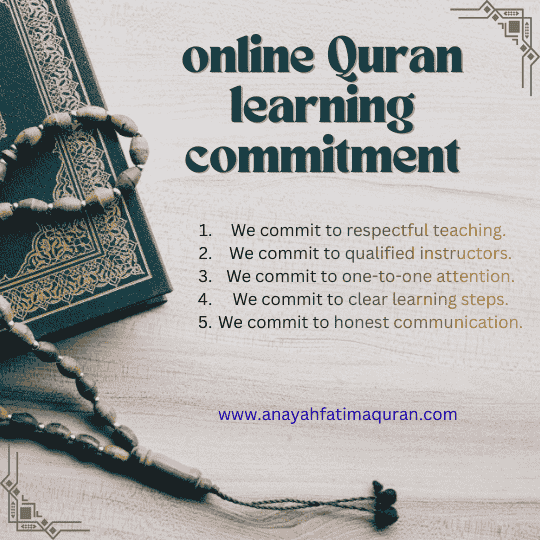
At Anayah Fatima Online Quran Academy, our commitment is clear. It is not a list of features. It is a written standard that every teacher, every class, and every conversation must meet. Families who read this page will know exactly what to expect from us before they book a single session.
This page covers everything. Teacher quality, one-to-one structure, parent transparency, child safety, fee honesty, schedule flexibility, and the things we simply will not promise. Read it fully. Ask us questions. Then decide. Our commitment starts the moment you contact us.
What Our Commitment Actually Means for Your Family
Our commitment is not marketing language. It is a set of specific standards we hold ourselves to in every class we run. Most online academies use words like commitment, quality, and trust freely. We define what those words mean in practice.
Our commitment covers how we select teachers, how we structure learning, how we keep families informed, how we protect students, and how we handle money and scheduling. Each of these areas is covered in detail below. Together they form a complete picture of what it means to learn Quran with us.
The Difference Between Our Commitment and a Guarantee
A guarantee promises a specific result. Our commitment promises a standard of care. These are not the same thing. We commit to teaching correctly. We commit to communicating honestly. We commit to protecting every student’s dignity. We do not guarantee your child will memorise the Quran in a set number of months.
The Prophet Muhammad, peace be upon him, said: The most beloved deeds to Allah are those done consistently, even if they are small. (Sahih al-Bukhari, 6465). Consistency in teaching and in learning produces real results. That is the foundation of our commitment.
Five Pillars of Our Commitment
Our commitment rests on five areas. First, teacher quality and verification. Second, one-to-one learning with full attention. Third, transparent and honest parent communication. Fourth, child safety and dignity in every session. Fifth, clear fees and flexible scheduling with no hidden costs. Each pillar is explained in the sections that follow.
Free Trial Class | Our Commitment Starts Before You Pay
Every family begins with a free one-to-one trial class. This is not a sales call. It is not a ten-minute demo. It is a complete, live teaching session with a verified teacher. The family sees exactly how we teach before spending a single pound, dollar, or rupee.
Competitors like EQuran School and Mishkah Academy also offer free trials. The difference is what happens during that trial. Many academies use the trial session to present courses and pricing. We use it entirely for teaching and assessment. The student reads. The teacher listens. The family observes.
What Happens Inside the Free Trial Class
The session follows a clear structure. The teacher introduces themselves briefly and explains the session plan. The student reads from their current level, whether that is Arabic letters, Noorani Qaida, or a Surah from the Quran. The teacher listens, assesses accuracy, identifies gaps, and gives the student gentle feedback during the session itself.
Parents observe the full session. They can ask questions at any point. By the end, they have seen the teaching style, heard how the teacher corrects, and understand where their child stands. No commitment is made. The family decides at their own pace.
No Obligation After the Trial
There is no automatic enrolment after the trial class. No invoice appears. No follow-up pressure comes. The family contacts us when they are ready. Some families enrol the same day. Some take a week to decide. Both are completely acceptable.
Research from Oxford University’s Department of Education confirms that parental confidence in a teacher’s approach is the strongest predictor of long-term student enrolment. The free trial gives families the direct experience they need to feel confident. This is where our commitment begins, before any payment is made.
Teacher Quality | The Most Important Part of Any Commitment
Teachers shape a child’s relationship with the Quran permanently. A child who learns with a patient, accurate, qualified teacher builds correct habits that last a lifetime. A child who learns with an unqualified or impatient teacher develops errors that take years to correct. This is why teacher selection is the most critical part of our commitment.
Many online academies list teacher credentials without explaining how those credentials are verified. We verify before any teacher meets a student.
Our Teacher Selection Process
Every teacher applicant goes through three stages before joining. Stage one is recitation verification. The applicant demonstrates their Quran recitation to our academic review team. We check for correct Tajweed application including Madd, Ghunnah, Qalqalah, Idgham, and Ikhfa. If recitation is not accurate, the applicant does not proceed.
Stage two is teaching background review. We examine their experience with children and adults, their familiarity with Noorani Qaida, and their approach to correction and patience. Stage three is a mock teaching session. They teach a sample student while we observe. We assess how they explain, how they correct mistakes, and how they handle a student who is struggling. Teachers who pass all three stages join us. Those who do not are not placed with students.
Our Teacher Selection Process
Every teacher applicant goes through three stages before joining. Stage one is recitation verification. The applicant demonstrates their Quran recitation to our academic review team. We check for correct Tajweed application including Madd, Ghunnah, Qalqalah, Idgham, and Ikhfa. If recitation is not accurate, the applicant does not proceed.
Stage two is teaching background review. We examine their experience with children and adults, their familiarity with Noorani Qaida, and their approach to correction and patience. Stage three is a mock teaching session. They teach a sample student while we observe. We assess how they explain, how they correct mistakes, and how they handle a student who is struggling. Teachers who pass all three stages join us. Those who do not are not placed with students.
Female Quran Teachers for All Female Students
Female Quran teachers are a standard option for all female students and children. This is not an extra service that costs more. When a female student enrols, a female teacher is assigned by default. Families do not need to request this specifically, though they are welcome to confirm it at enrolment.
Our female teachers cover time zones across the UK, USA, Canada, Australia, and Gulf countries. No female student needs to wait for a specific slot or accept a male teacher because no female teacher is available. This standard is consistent across all programmes.
Teacher Change Policy — Student Comfort Is Not Negotiable
Not every teacher matches every student. A young, shy child may need a gentler approach. An adult learner may want someone who moves at a quicker pace. When a mismatch happens, we respond.
Families who report that their child is uncomfortable with the assigned teacher receive a teacher change within one to three working days. The new teacher reviews notes from previous sessions. The student does not repeat material already covered. The change is smooth. Our commitment to student comfort is non-negotiable.
One-to-One Quran Learning | Why It Produces Better Results
Group Quran classes have existed for centuries. Traditional Mosque circles gathered students around a single teacher. In that setting, the teacher could walk around, listen to each student, and give personal correction. Online group classes cannot replicate this. When eight students appear on a single video call, individual correction becomes rare. Quiet students fall behind without saying anything.
We offer only one-to-one sessions. One teacher. One student. Full attention in every minute of every class.
What Full Attention Produces in Practice
In a one-to-one Quran class, the teacher hears every single word the student recites. Every mispronounced letter is caught immediately. Every hesitation is noticed and addressed. The teacher adjusts their speed, their explanation, and their level of support in real time based on what the student does in that exact moment.
A University of Melbourne study on individual instruction found that students in one-to-one settings achieve 30 percent higher skill retention compared to group instruction. In Quran learning, where correct pronunciation and precise rules must be absorbed and retained, this difference is significant.
Session Structure | What a Typical Class Looks Like
Every session follows a consistent structure. The class begins with revision of the previous lesson. The teacher asks the student to repeat material from the last session before introducing anything new. New material is then introduced step by step. The student practises while the teacher listens and corrects. The session closes with a brief summary and specific guidance on what to practise before the next class.
This structure gives students clear direction. It gives parents easy visibility into what their child is learning. It builds a learning rhythm that produces consistent progress over time.
Session Length Options | Thirty and Forty-Five Minutes
Sessions are available in two lengths. Thirty-minute sessions suit young children whose concentration spans are shorter. Forty-five-minute sessions suit older children, teenagers, and adults who can sustain focused learning for longer.
Families choose their session length at enrolment. The choice can be adjusted later as the student grows older or as their concentration develops. Many families start young children on thirty-minute sessions and move to forty-five minutes after six to twelve months when the routine is established.
Learning Pace | We Follow the Student, Not the Schedule
Every learner moves at a different speed. A five-year-old starting Arabic letter recognition moves differently from a teenager beginning Quran reading. An adult who studied Arabic in school progresses faster through Noorani Qaida than one starting with no prior knowledge. We build our teaching around these realities. We do not set a timetable and force students through it.
Level Assessment | How We Place Every Student
Every new student, regardless of prior learning, begins with a level assessment during the free trial. We do not assume. We listen. The teacher asks the student to read from a specific point and assesses accuracy, fluency, and Tajweed application.
A student who can read Arabic letters but has not started Noorani Qaida begins there. A student who reads the Quran but makes consistent Tajweed errors works on those rules specifically. A complete beginner starts from letter recognition. A student transferring from another academy is assessed on their actual performance, not on what their previous academy reported.
The Standard Learning Path Qaida to Quran to Hifz
The standard learning path follows a clear sequence. Students begin with Noorani Qaida if they are beginners. Noorani Qaida teaches Arabic letter recognition, short vowels, letter joining, and basic pronunciation rules. Once Qaida is complete, students move to Quran reading. When reading is accurate and fluent, Tajweed rules are introduced formally. Students who wish to memorise pursue Hifz after reading fluency is established.
This sequence is not rigid. Students who already read the Quran do not return to Qaida. Students with strong reading but weak Tajweed focus on correction before moving forward. The teacher decides each step based on the student’s actual performance.
Handling Students Who Need Extra Time
Some students take longer at each stage. This is normal. A student who needs extra time on a specific Tajweed rule gets extra time. A student who finds letter joining difficult stays there until it is solid. We do not push students forward before they are ready.
When progress is slower than expected, we discuss this with the parent openly. We explain the specific challenge, what the teacher is doing to address it, and what the family can do to support practice at home.
Parent Transparency | You Will Always Know What Is Happening
Parents choose an online academy on trust. They cannot sit in every class. They cannot hear every word their child recites. They depend on us to keep them informed clearly and honestly. We build transparency into our regular process, not just when parents ask.
Progress Updates | Specific, Not Vague
Teachers provide progress updates at regular intervals. For students attending twice weekly, updates are shared monthly. Updates are specific. They do not say your child is doing well. They say your child has completed Noorani Qaida lessons one through twenty-two and is now beginning short vowel combinations. One specific area to practise at home is the letters with dots beneath them.
Specific feedback gives parents real information. It helps them celebrate genuine milestones. It tells them where home practice would help most. It connects families to the learning process even when they are not in the room.
Communication Between Classes
Families can contact us between classes whenever they have a question or concern. We respond within one business day. For urgent concerns, we respond faster. Communication channels are confirmed at enrolment. Families always know exactly who to contact and how.
We do not make families feel like a burden for asking questions. A parent who wonders whether their child is on track should ask. Involved parents produce more consistent, motivated students.
When We See a Problem, We Tell You
When we notice a student is struggling, we inform the parent. We do not wait for the parent to notice. If a student misses three consecutive classes, we reach out. If progress slows significantly, we flag it. If home practice is clearly not happening, we say so with care.
Honest communication sometimes means sharing things families would prefer not to hear. A child falling behind needs that information shared early, not hidden until the gap becomes large. We share difficult observations with respect and with a constructive plan attached.
Safe and Respectful Environment | Our Commitment to Child Safety
Online Quran learning happens inside a family’s home. Children are in private spaces. Sessions take place without another adult physically present in the room. This makes safety standards more important, not less.
Private Sessions With No Unwanted Recording
All sessions are private, one-to-one video calls. No other students are on the call. No third parties join without the family’s knowledge. We do not record sessions without explicit family permission. Families who want a session recorded for review can request this in advance.
The NSPCC, which is the National Society for the Prevention of Cruelty to Children in the UK, recommends that parents maintain clear visibility into their children’s online learning sessions. We fully support this. Parents can observe any session at any time without advance notice.
Teacher Conduct Standards | No Exceptions
Every teacher at Anayah Fatima Online Quran Academy operates under a strict code of conduct. Teachers address students respectfully at all times. They do not use harsh language. They do not shame students for mistakes. They correct errors with patience and clear explanation.
A student who mispronounces a letter is shown the correct position and asked to try again calmly. A student who forgets a Surah is given revision time without criticism. Learning the Quran should build a child’s confidence in Islam. Every session starts from that principle.
Female Teachers and Cultural Accommodations
For female students and children, female Quran teachers are assigned as standard. For families with specific cultural or religious requirements around online interaction, we work within those standards. Families who share their requirements at enrolment receive a clear response about how we accommodate them.
We understand that Muslim families hold different standards, especially in online settings. We respect this fully and build our default arrangements to meet the most careful standards first.
Schedule Flexibility | Quran Learning That Fits Around Your Life
Muslim families in the UK, USA, Canada, Australia, Gulf countries, and South Asia live in different time zones, follow different school calendars, and manage different daily routines. A rigid schedule serves only a fraction of the families who need Quran education. We build flexibility into every part of our scheduling.
Time Zones We Cover
Our teacher roster covers time zones from GMT minus eight to GMT plus six. Early morning slots are available for families in Gulf countries who prefer lessons after Fajr prayer. Evening slots serve students in the UK and Europe who study after school. Weekend-only schedules support families who cannot commit to weekday classes.
Families choose their preferred slot at enrolment. The same slot is reserved for them each week. Consistency in scheduling builds the routine that produces consistent progress.
Rescheduling — How We Handle Life Changes
Life changes. School exams arrive. Family events happen. Travel plans come up. When a class needs to move, families notify us at least twenty-four hours in advance and the session is rescheduled rather than lost. We do not penalise families for genuine disruptions. We arrange makeup sessions or credit arrangements so that learning keeps moving forward.
Ramadan and Seasonal Adjustments
Ramadan changes routines for every Muslim family. Families who want to increase Quran engagement during Ramadan can add extra sessions for that month. Families who need to adjust their schedule for Tarawih prayers or changed sleep patterns can do so. We plan Ramadan schedules in advance with families who raise it a few weeks before the month begins.
We also respect public holidays in the regions we serve. UK families are not expected to attend on bank holidays unless they choose to. USA families have flexibility around major holiday periods. These arrangements are communicated clearly and honoured consistently.
No Hidden Charges | Our Commitment to Fee Honesty
Financial trust is a core part of our online Quran learning commitment. Families should never feel surprised by what they are charged. Everything about our fee structure is explained clearly before the first paid class begins.
What the Monthly Fee Includes
The monthly fee covers the agreed number of weekly sessions, teacher assignment and continuity, progress reporting, parent communication, and access to our support team. There are no registration fees added on top. There are no material charges for lessons taught within standard programmes. There are no renewal fees.
Families pay for teaching time. The fee is agreed at enrolment, confirmed in writing, and does not change without advance notice of at least four weeks.
Sibling Discounts and Family Plans
Families who enrol more than one child receive a sibling discount. The rate is confirmed before any commitment is made. We apply sibling discounts consistently without requiring families to negotiate. No family should pay full price for a second or third child without first asking about family rates.
No Long-Term Contracts
Families pay monthly. There are no contracts that lock families into six or twelve-month commitments. A family who needs to pause for one month can pause. A family who wants to stop after any month can stop. We do not charge cancellation fees. We believe families continue because the teaching works, not because a contract holds them in place.
Progress Support | Guidance That Goes Beyond the Classroom
Progress in Quran learning does not happen only during class. It happens in daily practice between sessions. It happens in the revision that reinforces each lesson. Our commitment extends beyond the session hour.
Revision Built Into Every Session
Every class begins with revision of the previous lesson. The teacher asks the student to repeat material from the last session before introducing anything new. This structured revision ensures that material is not merely touched once and forgotten.
Cognitive science research on spaced repetition shows that returning to material at intervals significantly improves long-term retention. Our revision structure applies this principle directly. A student who forgets something during the week gets the chance to relearn it at the start of the next session.
Extra Support When Progress Slows
Learning sometimes slows. School exams create distraction. Illness interrupts routine. Life gets busy. When this happens, we adjust rather than increase pressure. The teacher may slow the pace, introduce additional practice exercises, or suggest more home practice time. In some cases, we recommend adding a temporary extra session per week. All changes are discussed with the family first.
Encouragement as a Core Teaching Method
The Prophet Muhammad, peace be upon him, said: Make things easy, do not make them difficult. (Sahih al-Bukhari, 69). Our teachers apply this daily. A child who hears specific, honest praise for a difficult letter they finally pronounced correctly will try harder on the next challenge. Our teachers name genuine progress clearly, without false praise and without holding it back.
What Our Commitment Does Not Include | Honesty Matters
Honesty means being clear about what we cannot guarantee. This section exists because we respect families too much to mislead them.
We Do Not Promise Fixed Completion Timelines
We cannot tell you that your child will complete Noorani Qaida in three months. One student may complete it in ten weeks. Another may take seven months. The difference depends on age, aptitude, practice consistency, and attendance frequency. Any academy that promises fixed timelines is not being honest.
We tell families what consistent effort typically produces. We share realistic expectations after the trial class assessment. We do not fabricate timelines to close enrolments.
We Do Not Promise Effortless Results
Quran learning requires effort. It requires practice. It requires repetition. The Quran was revealed over twenty-three years. The Companions of the Prophet, peace be upon him, memorised it slowly, carefully, and with deep dedication. There is no shortcut to learning it correctly.
Families who expect significant progress without home practice will be disappointed. We tell families this directly and kindly. If a student is not practising between sessions, we say so.
We Do Not Promise Every Session Will Be Perfect
Teachers are human. Occasionally a session may not run at its best. A technical issue may interrupt a call. A student may arrive tired. These things happen in any educational relationship. What we promise is our response. A session lost to a technical failure is rescheduled. A teacher who delivers a substandard session receives feedback from our team. We address problems when they occur.
Our Responsibility as a Quran Academy | The Deeper Side of Our Commitment
Teaching the Quran carries religious weight that no other subject carries. Allah says: Indeed, it is We who sent down the Quran and indeed, We will be its guardian. (Surah Al-Hijr, 15:9). The Quran is protected by Allah Himself. Our responsibility is to transmit it correctly with the same reverence that has carried it through fourteen centuries.
Teaching as an Amanah — A Sacred Trust
The word amanah means a trust placed in someone’s care. When a family enrolls their child with us, they place an amanah in our hands. That amanah is their child’s connection to the Quran, their ability to read Salah correctly, their relationship with Islam for the rest of their life. Our commitment to this trust is what separates sincere teaching from a commercial transaction.
Every teacher at Anayah Fatima Online Quran Academy understands this. They do not treat Quran teaching as merely a job. It is a responsibility they carry consciously in every session they teach.
Continuous Teacher Development
Our commitment to quality does not stop when a teacher joins us. We monitor teaching standards through periodic academic review sessions. Teachers receive feedback from our review team. Teachers who want to develop specific skills, such as advanced Tajweed correction methods or specialised approaches for very young learners, receive support to do so. Better teachers produce stronger students.
Success Stories | Real Families, Real Results
These stories represent real families whose experiences reflect our commitment in practice. Names and some identifying details have been adjusted for privacy where families requested.
How We Compare to Other Options | An Honest Look
| Area | Anayah Fatima Academy | EQuran School | Mishkah Academy | Local Mosque Class | Generic Online Platform |
|---|---|---|---|---|---|
| Class Format | One-to-one only | One-to-one | One-to-one | Group 10 to 30 students | Varies, often group |
| Teacher Verification | Multi-stage academic review | Certified tutors | Certified tutors | Variable | Variable |
| Female Teachers | Assigned as default | Available on request | Available | Often unavailable | Varies by platform |
| Free Trial | Full one-to-one teaching session | Available | Available | Not typical | Demo only |
| Tajweed Standard | Verified for every teacher | Certified | Certified | Varies widely | Not guaranteed |
| Parent Progress Reports | Regular, specific, written | Not detailed | Not detailed | Rare or verbal | Automated only |
| Schedule Flexibility | All time zones, full flexibility | Flexible | Flexible | Fixed local times | Varies by plan |
| Hidden Fees | None whatsoever | Registration fees may apply | Varies | Donation expected | Platform fees common |
| Rescheduling Policy | 24 hours notice, session not lost | Varies | Varies | Class typically lost | Varies by plan |
| Child Safety Standards | Open sessions, parental access always | Standard platform | Standard platform | Shared physical space | Platform dependent |
| Teacher Change | Within 1 to 3 days on request | Available | Available | Not available | Rarely available |
| Sibling Discount | Standard and consistent | Available | Available | Not applicable | Varies |
| Session Length Options | 30 or 45 minutes | Fixed | Fixed | Fixed | Fixed |
| Contract Type | Monthly only, no lock-in | Varies | Varies | Weekly or term | Often annual |
Your Role in This Learning Partnership
Our commitment works best when families are involved. We bring the teachers, the structure, the honest communication, and the care. Families bring the consistency that makes progress real.
Regular Attendance Matters More Than Anything Else
Consistent attendance is the single biggest factor in Quran learning progress. A student who attends every class and practises between sessions will advance. A student who misses classes frequently, even with qualified teaching, will not progress at the same rate. This is a fact we share honestly at enrolment.
Families who protect their child’s class schedule and treat the Quran session as a consistent weekly appointment give their child the best possible chance. We support this by making scheduling as easy as possible and by flagging when attendance has become irregular.
Daily Practice Between Sessions
Fifteen minutes of daily practice between sessions produces noticeably better results than practice only on class days. This is not a large commitment. Fifteen minutes each day means the next class builds on solid ground rather than starting again from scratch.
We suggest specific practice tasks at the end of every session. The teacher tells the student and parent exactly what to practise and how. Families who follow this guidance see clear results within weeks.
Sharing Concerns Early Helps Everyone
Families who share concerns early help us respond before small issues grow into larger ones. If a child seems bored, tell us. If a student is struggling with a specific letter at home, tell us. If a family is going through a difficult period that may affect attendance, tell us. We respond with practical adjustments, not judgment.
Why Families Choose Anayah Fatima Over Larger Academies
There are many online Quran academies today. EQuran School has been running since 2008. Mishkah Academy offers dozens of specialised courses. International Quran Academy serves students across multiple countries. These are established organisations.
What makes Anayah Fatima different is not a longer course list. It is the care that exists behind every class we teach.
We Do Not Overload Teachers
Large academies sometimes assign teachers to twenty or thirty students simultaneously. A teacher managing that many students cannot track each one’s progress carefully. They cannot notice when a specific student has developed a new error. They cannot follow up with each parent individually.
We keep teacher workloads at a level where individual attention is real, not just a phrase on a website. Every teacher knows their students by name, by level, and by the specific challenges each one faces.
We Serve Families, Not Numbers
We measure success by whether students are actually learning. Not by how many students are enrolled. A student who completes Noorani Qaida correctly and moves to Quran reading with accurate pronunciation is a success. That is what we aim for in every class.
Our Commitment Is Specific, Not Generic
Many online academies make the same general promises. Qualified teachers, flexible schedules, free trial, one-to-one classes. These are common claims in the industry. What separates a real commitment from marketing copy is the specifics. This page is full of specifics because we mean what we say.
Frequently Asked Questions About Our Commitment
How do I verify that the teacher is qualified to teach Tajweed?
Every teacher passes a recitation verification review with our academic team before teaching any student. We check for correct application of rules including Madd, Ghunnah, and Qalqalah. You can also ask your assigned teacher to demonstrate any Tajweed rule during the first session. We encourage this. A qualified teacher welcomes the question. If you are ever unsatisfied with recitation accuracy, contact us immediately and we will respond within one business day.
Can I sit with my child during their Quran class?
Yes, always. Parents are welcome in any session at any time without advance notice. Many parents attend occasionally and find it helpful for understanding their child’s level and the teacher’s methods. If your child is very young, we actually recommend having a parent present during the early sessions to help with focus and participation.
What if my child misses classes due to illness or a school event?
Contact us as early as possible when you know a class needs to be missed. We arrange a makeup session or note the absence for billing review. We do not penalise families for genuine disruptions. Consistent long-term absenteeism will be discussed with the family because it directly affects progress, but isolated missed sessions are managed without stress or penalty.
From what age do you accept Quran students?
We accept students from age four onward. Children under six attend with a parent present. Very young children follow thirty-minute sessions focused on basic letter recognition and age-appropriate Quran engagement. A four-year-old is not expected to sit through structured Tajweed instruction. The teacher meets the child where they are developmentally and builds from there.
How long does Noorani Qaida typically take to complete?
This varies by student. A child aged six attending twice weekly with ten minutes of daily practice typically completes Noorani Qaida in four to seven months. A child attending once per week without home practice may take twelve to eighteen months. An adult attending consistently and practising daily often completes it in three to five months. We give a realistic estimate after the trial class assessment, not a fixed guarantee.
Can adults who have never learned Arabic start from the beginning?
Absolutely. Many of our adult students begin with zero Arabic knowledge. The free trial places you at the correct starting point. Adult beginners start with Noorani Qaida. Many adults progress faster than they expect when they have consistent one-to-one teaching and follow a structured revision plan. Age is not a barrier. We have students who began in their forties and read the Quran fluently today.
What happens if I am not satisfied with teaching quality?
Contact us directly. Tell us what happened. We review the feedback with the teacher and respond within one business day. If the issue is a teacher-student mismatch, we arrange a change promptly. If the issue is a one-time problem, we acknowledge it and monitor the following sessions closely. We do not dismiss concerns and we do not ask families to simply accept poor quality.
Do you offer additional sessions during Ramadan?
Yes. Families who want to increase Quran learning during Ramadan can add sessions for that month. Standard sessions continue unless a family requests a pause. Families who want to use Ramadan for Hifz revision or to complete a specific programme can arrange a focused plan with their teacher. We recommend discussing Ramadan schedules a few weeks before the month begins.
What payment methods do you accept and in which currencies?
We accept payment by bank transfer, PayPal, and local payment methods depending on the country. UK families pay in GBP. USA and Canada families pay in USD or CAD. Gulf families pay in AED or SAR. Pakistan families pay in PKR through local transfer. All payment details are confirmed at enrolment before any charge is made.
My child has been learning elsewhere. Do they start from the beginning again?
No. Every student begins with a free trial assessment regardless of prior experience. The teacher evaluates their current level during the trial. Prior learning is respected where it is accurate. Where incorrect habits have formed, the teacher identifies them and explains a correction plan. Many students who join from other academies have a solid foundation and begin from an advanced point.
Is there a sibling discount for families with multiple children?
Yes. The rate is confirmed before any payment is made. Sibling discounts are standard and consistent. No family should pay full price for a second or third child without first asking about family rates. We apply the discount automatically once enrolment is confirmed.
What if my child stops making progress?
We address this with the family directly. First, we identify the cause. Is the student missing classes? Not practising between sessions? Struggling with a specific concept? Each cause has a different response. We share what we observe honestly and suggest a specific plan. Progress plateaus are normal in language learning. They are not permanent. We work through them together.
Can I change the class schedule after enrolment?
Yes. Life changes and we understand this. If your routine changes, contact us. We find a new slot that suits your updated schedule. Changes may take a few days to arrange based on teacher availability in your preferred time zone, but we accommodate schedule changes as a standard part of how we work.
What happens if the teacher and student do not connect well?
We handle it quickly. Families who report a mismatch receive a teacher reassignment within one to three working days. The new teacher reviews session notes so the student does not repeat material. We do not ask families to simply adapt. Student comfort and progress both matter.
Start With Confidence | Your First Step Has No Risk
You do not need to trust us on words alone. This page describes our commitment in detail. The free trial class lets you test it in practice.
Book a free one-to-one trial class. Meet the teacher. Watch how they assess your child. See how they correct. Hear how they explain. Ask every question you have about teaching methods, teachers, fees, or anything else on this page.
If the trial meets your expectations, enrol. If it does not, you have lost nothing. No charge. No obligation. No pressure.
Contact Information: WhatsApp/Call: +92-322-4553480 Email: contact@anayahfatimaquran.com
Your Quran journey begins with one step. That step is free and carries no risk.